Aww, someone decided that they no longer need inspiration. That, or they’ve simply given up. Not sure how to feel about this one.
Regardless, I’m taken with the symbolism inherent in a framed motivational poster bearing the word “attitude” and being slumped against a dumpster.
Saturday, May 7, 2011
Thursday, May 5, 2011
The Two McBains
A few months ago the internet exploded with geek joy when its users realized that the various McBain clips from the early seasons of The Simpsons could be viewed in order to form a kinda-sorta fully plotted mini-movie.
(Yes, it takes little to make the internet explode, particularly when the subject matter draws on nostalgia. Did you know that the theme to India Jones, when played backwards, sounds exactly like the theme to Star Wars? That’s not true, but could you imagine the geekgasm that would beslime monitors across the globe if it were? Oh, there would be Reddit threads.)
Today, I present something to you that, by my personal standards, blows McBain out of the water: and that thing is McBain. It’s a movie. Like, a real movie, released in 1991, well after McBain the character began appearing on The Simpsons. And like the Simpsons character, this actual, live action McBain employs every hackneyed late 80s-early 90s action trope you could imagine. Observe:
Oh, and Christopher Walken plays the titular assassinator-and-quipper, so total bonus points. (Maria Conchita Alonso is also in it, but that’s a neutral, decides the world.)
Although the McBain movie developed separately from and subsequently to the Simpsons character, and although the pop cultural impact of this movie more or less amounts to zero, it still influenced the show. According to Wikipedia, after McBain hit theaters, its producers prevented the show from using the name for some years. As a result, the Simpsons writers wrote onto the show that McBain was only a character and that Schwarzeneggeresque actor who played him was actually Ranier Wolfcastle. Thus, thank this terrible Christopher Walken movie for the fact that you know who Ranier Wolfcastle is.
The Simpsons, previously:
Today, I present something to you that, by my personal standards, blows McBain out of the water: and that thing is McBain. It’s a movie. Like, a real movie, released in 1991, well after McBain the character began appearing on The Simpsons. And like the Simpsons character, this actual, live action McBain employs every hackneyed late 80s-early 90s action trope you could imagine. Observe:
Oh, and Christopher Walken plays the titular assassinator-and-quipper, so total bonus points. (Maria Conchita Alonso is also in it, but that’s a neutral, decides the world.)
Although the McBain movie developed separately from and subsequently to the Simpsons character, and although the pop cultural impact of this movie more or less amounts to zero, it still influenced the show. According to Wikipedia, after McBain hit theaters, its producers prevented the show from using the name for some years. As a result, the Simpsons writers wrote onto the show that McBain was only a character and that Schwarzeneggeresque actor who played him was actually Ranier Wolfcastle. Thus, thank this terrible Christopher Walken movie for the fact that you know who Ranier Wolfcastle is.
The Simpsons, previously:
Read more:
movies,
pop culture minutiae,
the simpsons,
tv
Wednesday, May 4, 2011
Shelly Duvall’s Hips
So there’s three things going on here: my fascination with bad 80s pop music, a childhood fondness for Dr. Demento and my fascination with horrible, strange things that defied plausibility and happened. The three may well be related.
First, the soundtrack to a neon sweatband generation. I have a complicated relationship with “Bette Davis Eyes.” If I hear it, it plays in my head over and over to the point that the experience verges on post-traumatic stress disorder. However, I can’t completely hate the song, possibly because there’s value in a pop culture relic that builds upon an even older pop culture relic, possibly because the song actually has a few neat turns of phrase, like “She knows what it takes to make a pro blush,” which is funny once you realize what it’s talking about. (Answer: whores.)
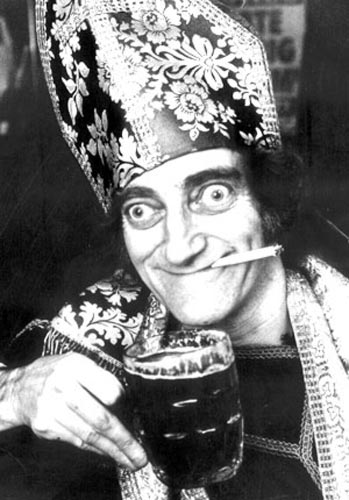
Today, Spencer sent me a link to the lyrics to a parody version that came out shortly after Kim Carnes’s cover of “Bette Davis Eyes” became a hit: “Marty Feldman Eyes.” Yes, between the respective reigns of Peter Lorre and Steve Buscemi, Feldman was Hollywood’s go-to man with the googly eyes. See?
People would probably most often recognize Feldman as Igor in Young Frankenstein, but he found success in a few other roles, at least to the point that he was famous enough that people would understand what a song titled “Marty Feldman Eyes” was funny.
And here’s where I get to the third part of today’s post: the strange death of Marty Fedlman. I could try to put tin my own words, but there’s really nothing more I could add than what Wikipedia has, so here are the two paragraphs verbatim:
First, the soundtrack to a neon sweatband generation. I have a complicated relationship with “Bette Davis Eyes.” If I hear it, it plays in my head over and over to the point that the experience verges on post-traumatic stress disorder. However, I can’t completely hate the song, possibly because there’s value in a pop culture relic that builds upon an even older pop culture relic, possibly because the song actually has a few neat turns of phrase, like “She knows what it takes to make a pro blush,” which is funny once you realize what it’s talking about. (Answer: whores.)
Today, Spencer sent me a link to the lyrics to a parody version that came out shortly after Kim Carnes’s cover of “Bette Davis Eyes” became a hit: “Marty Feldman Eyes.” Yes, between the respective reigns of Peter Lorre and Steve Buscemi, Feldman was Hollywood’s go-to man with the googly eyes. See?
People would probably most often recognize Feldman as Igor in Young Frankenstein, but he found success in a few other roles, at least to the point that he was famous enough that people would understand what a song titled “Marty Feldman Eyes” was funny.
Her head is growing baldSo maybe Bruce Baum isn’t for everyone, and even at the time the song came out it wouldn’t have exactly been incisive comedy, but I had a laugh reading the lyrics. But it got me thinking: Why the hell did Marty Feldman’s eyes look like that, anyway? (Answer: whores. Wait, no. Graves’ disease. But whores would have been funnier.) But, as I learned by reading about him, it wasn’t the disease that killed him. No, it’s much more interesting that that.
Her feet are twice her size
She says it’s not her fault
She's got Marty Feldman eyes
She’ll turn the sprinklers on you
And dry you off with her thighs
She'll confuse the hell out of you
She’s got Marty Feldman eyes
And she’ll woo you
Then she’ll moon you
And forget to pull her pants up
She’s obnoxious
And she knows it
And she knows how to blow her nose up
All the boys think she’s fried
She’s got Marty Feldman eyes
She’s ferocious
Narcoleptic
Ambidextrous
Supercalafragalisticexpialadocious
Bogus
Vegamatic
All the boys think she’s a guy
She's got Marty Feldman eyes
And Jimmy Walker’s lips
Liberace’s clothes
Shelly Duvall’s hips
She’s got Willie Nelson legs
And Nancy Reagan’s spleen
Dolly Parton’s lungs
She’s got Leon Spinks’s teeth
Bob Seger’s pancreas
All the boys think she's some kind of guy
She’s got Marty Feldman eyes
And here’s where I get to the third part of today’s post: the strange death of Marty Fedlman. I could try to put tin my own words, but there’s really nothing more I could add than what Wikipedia has, so here are the two paragraphs verbatim:
Feldman died from a heart attack in a hotel room in Mexico City on 2 December 1982, during the making of the film Yellowbeard. Cartoonist Sergio Aragonés was filming nearby, and dressed for his role as an armed policeman. Aragonés abruptly encountered Feldman while introducing himself, frightening Feldman, and possibly inducing his heart attack. Aragonés has recounted the story with the punchline “I killed Marty Feldman.” The story was converted into a strip in Aragonés’s issue of DC Comics’ Solo.Rest in peace, Googly Eyes. Now, the next time I watch Young Frankenstein, I’ll be thinking about that instead of “Why the hell do Marty Feldman’s eyes look like that?”
On the DVD commentary of Young Frankenstein, Mel Brooks cites additional factors that may have contributed to Feldman's death: He smoked sometimes six packs of cigarettes daily, drank copious amounts of coffee, and ate a diet rich in eggs and dairy products. Michael Mileham, who made the behind-the-scenes movie Group Madness about the making of Yellowbeard, said he and Feldman swam to an island where a local was selling lobster and coconuts. Mileham and Feldman used the same knife on their lobsters. Mileham said he got shellfish poisoning the next day, and theorized that since Feldman used the same knife he also could have been poisoned.
Read more:
bad things pop music did,
bette davis,
marty feldman,
music,
now that's interesting
Tuesday, May 3, 2011
Whatever the Opposite of the Luck of the Irish Is
Someone — and trust me when I tell you that the circumstances notwithstanding, he’s a well-wisher — recently sent me the text to a famous Irish curse. And if any nationality has the inherent way with words and the experience with staggering tragedy to hurl a good hex, it’s the Irish. See for your self:
But I’ve since been brainstorming other curses — less altogether damning but nonetheless unpleasant. Please, if you have the time, try on these curses and tell me how they fit:
May the grass grow at your door and the fox build his nest on your hearthstone.See? Pretty brutal, at least once you get past the quaint, rustic appeal of grass growing at the doorstep and the initial cuteness of a fox living in your fireplace. (You wouldn’t be able to light a fire because it would probably bite at you. You’d be so cold! Your potatoes would be eaten raw!) It seems especially cruel to request the addressee to die without getting the proper send off from the proper holy man, especially considering the presumably Irish target audience for such a curse.
May the light fade from your eyes, so you never see what you love.
May your own blood rise against you, and the sweetest drink you take be the bitterest cup of sorrow.
May you die without benefit of clergy.
May there be none to shed a tear at your grave, and may the hearthstone of hell be your best bed forever.
But I’ve since been brainstorming other curses — less altogether damning but nonetheless unpleasant. Please, if you have the time, try on these curses and tell me how they fit:
May your every business email become, between you and the recipient, riddled with inappropriate emoticons.
May your birthmarks begin to form obscene pictures.
May your acid reflux always make you throw up, just a little bit.
May your stupid baby never grow into her nose.Awful things:
May a clerical error in the doctor’s office result in your family being erroneously told that, in the moments before your death, you were mad with syphilis.
May your children remember you in embellished, unflattering tell-alls published so soon after your death that everyone presumes that they’d begun working on them before your death.
May your dog find a home with a new family, and may it be remarked by your neighbors that the dog looks much happier now. Thinner, too.
May you, while on your deathbed, learn that there’s a certain word that you’ve been pronouncing wrong for most of you life. And it’s a word you used a lot. And you feel really stupid.
May you, in your final moments, have really bad sick people farts.
And, to reiterate, the clergy is not there.
Well, if there is a clergyman there, he’s from a faith that you find pretty offensive. And even the clergyman is like, “Yeah, this is super awkward.”
May your will be confusing and cause much squabbling among your survivors, at least until they realize all your stuff is garbage and they just forget about the whole damn thing.
And, in closing, may your tomb eventually be developed upon, and may the family occupying the house you end up haunting find your presence to be “fun,” despite your best efforts.
Read more:
all things verbal,
awful things,
curse,
death,
things irish
Monday, May 2, 2011
The Spaghetti of Yesteryear
Apparently I own a spaghetti stick, and I’m okay with that, since I tend to misjudge how much food to cook for the total number of occupants in my one-bedroom apartment. (God help me if I choose to cook rigatoni, however.) But actually looking at this thing, this device that minimizes the difference between the size of your eyes and the size of your stomach, I feel like it has some outdated ideas about how much humans eat.
Does a woman actually eat about as much as a ten- to twelve-year-old kid? Is my spaghetti stick calling most women fat?
Food-related mysteries, previously:
Does a woman actually eat about as much as a ten- to twelve-year-old kid? Is my spaghetti stick calling most women fat?
Food-related mysteries, previously:
Read more:
food
So You Can Make a Killing
Lesson learned: Fortune does not smile on female high school seniors living in a close-knit Washington community and involving themselves in sexual relationships with the shadier inhabitants, for you will end up a waterlogged corpse. (If you live in any other state, however, go to town.)
First off, I should admit that I’ll watch whatever AMC offers me in a manner similar to how certain women will do anything Oprah Winfrey tells them to. That being said, AMC delivers more often than not. And I’m enjoying the hell out of The Killing. I waited until this quiet, stay-at-home weekend to burn through the episodes aired so far, and it paid off enough that I’ll be perfectly happy to wait as the remaining ones trickle onto iTunes week by week.
You could easily compile a list of words and phrases that every review of The Killing had included. Among them: “slow-burning,” “atmospheric,” “chilling” and, in more words or less, “Twin Peaks-y minus the goofiness, demon owls and backwards talking.” And they’re right. It’s hard not to draw parallels between the two series, especially when the dead girl makes her first posthumous appearance in a handheld video, standing beside her high school bestie in happier times.
But for me, the comparison to be made here is between The Killing and every other crime procedural on the air now. See, watching the pilot to The Killing is damn near frustrating simply because it takes the investigating officers nearly the whole hour to discover Rosie Larsen’s dead body, even though the viewer watchers her final moments in the series’s first. Hell, even people not watching the show know that Rosie’s a goner, given the “Who killed Rosie Larsen?” promotional campaign making amateur detectives of anyone passing a bus or billboard in the metropolitan U.S. But now that the investigation has begun, the show has proven how much more satisfying it is to watch a gradually building, longterm mystery than it is to plunk for a CSI or any of the other crime procedurals and get from “Shit! A dead body!” to “J’accuse!” in the span of an hour. These shows offer an interchangeable team of quirky investigators who interact with whatever suspects-of-the week and root out the murderer, with the only real difference from episode to the next being the theme. (The one I’ll give a pass to is Bones, which mixes gore and humor in a way I don’t think any other network series can, and which actually allows its cast to act and experience character growth.) Here, the producers weren’t exaggerating when they said the meat of The Killing is how Rosie’s death has affected the lives of the show’s living characters. I’d watch Brent Sexton and Michelle Forbes tear into their roles even without the payoff of Rosie’s murder getting solved. And by the way: Can Michelle Forbes get some sort of award for being the go-to actress for cult TV series? Star Trek: The Next Generation, Homicide, 24, Battlestar Galactica, Lost, True Blood, now this. The lady rules.
The other giant plus that The Killing has going for it is its status as a miniseries and not a season-to-season show. Unless I’m mistaken, The Killing will reveal who killed Rosie Larsen by the thirteenth episode, which has already been filmed, which means that even if AMC decides to spit in the faces of critics and cancel this glowingly reviewed show, fans would still get to an ending. (AMC won’t do that; I’m just speaking hypothetically.) This is how TV should be made: in complete story arcs, BBC miniseries-style, and not in the way that can lead to resolution-less cliffhangers like the one that sent off Twin Peaks. (Yeah, I’ve looped back to Twin Peaks even after trying to pull the conversation in another direction. I wonder if this is how David Lynch feels.) Hopefully, the quality of The Killing won’t nosedive in the second half — you know, like what happened with Twin Peaks — and other networks will commit to one-shot series that each have a beginning and an end. You know, like how stories are meant to be told.
First off, I should admit that I’ll watch whatever AMC offers me in a manner similar to how certain women will do anything Oprah Winfrey tells them to. That being said, AMC delivers more often than not. And I’m enjoying the hell out of The Killing. I waited until this quiet, stay-at-home weekend to burn through the episodes aired so far, and it paid off enough that I’ll be perfectly happy to wait as the remaining ones trickle onto iTunes week by week.
You could easily compile a list of words and phrases that every review of The Killing had included. Among them: “slow-burning,” “atmospheric,” “chilling” and, in more words or less, “Twin Peaks-y minus the goofiness, demon owls and backwards talking.” And they’re right. It’s hard not to draw parallels between the two series, especially when the dead girl makes her first posthumous appearance in a handheld video, standing beside her high school bestie in happier times.
But for me, the comparison to be made here is between The Killing and every other crime procedural on the air now. See, watching the pilot to The Killing is damn near frustrating simply because it takes the investigating officers nearly the whole hour to discover Rosie Larsen’s dead body, even though the viewer watchers her final moments in the series’s first. Hell, even people not watching the show know that Rosie’s a goner, given the “Who killed Rosie Larsen?” promotional campaign making amateur detectives of anyone passing a bus or billboard in the metropolitan U.S. But now that the investigation has begun, the show has proven how much more satisfying it is to watch a gradually building, longterm mystery than it is to plunk for a CSI or any of the other crime procedurals and get from “Shit! A dead body!” to “J’accuse!” in the span of an hour. These shows offer an interchangeable team of quirky investigators who interact with whatever suspects-of-the week and root out the murderer, with the only real difference from episode to the next being the theme. (The one I’ll give a pass to is Bones, which mixes gore and humor in a way I don’t think any other network series can, and which actually allows its cast to act and experience character growth.) Here, the producers weren’t exaggerating when they said the meat of The Killing is how Rosie’s death has affected the lives of the show’s living characters. I’d watch Brent Sexton and Michelle Forbes tear into their roles even without the payoff of Rosie’s murder getting solved. And by the way: Can Michelle Forbes get some sort of award for being the go-to actress for cult TV series? Star Trek: The Next Generation, Homicide, 24, Battlestar Galactica, Lost, True Blood, now this. The lady rules.
The other giant plus that The Killing has going for it is its status as a miniseries and not a season-to-season show. Unless I’m mistaken, The Killing will reveal who killed Rosie Larsen by the thirteenth episode, which has already been filmed, which means that even if AMC decides to spit in the faces of critics and cancel this glowingly reviewed show, fans would still get to an ending. (AMC won’t do that; I’m just speaking hypothetically.) This is how TV should be made: in complete story arcs, BBC miniseries-style, and not in the way that can lead to resolution-less cliffhangers like the one that sent off Twin Peaks. (Yeah, I’ve looped back to Twin Peaks even after trying to pull the conversation in another direction. I wonder if this is how David Lynch feels.) Hopefully, the quality of The Killing won’t nosedive in the second half — you know, like what happened with Twin Peaks — and other networks will commit to one-shot series that each have a beginning and an end. You know, like how stories are meant to be told.
Read more:
the killing,
tv,
twin peaks
Sunday, May 1, 2011
Quite the Dinner Party They’ve Assembled Here
Hate to use a cliche, but one of these things is indeed not like the others.
Morbidly curious? Watch the video to see convicted serial killer James Alcala win on the The Dating Game and prove that years of slasher movies have at least taught women that the guys who look, act, and speak like serial killers may in fact be serial killers.
Read more:
serial killers,
the dating game,
things creepy and/or horrifying,
tv
Subscribe to:
Posts (Atom)