
Monday, April 19, 2010
Son of Sniglet
A quick reminder: I got some good abstract song suggestions for my little music game that I began last Monday. (I think my favorite so far is “Theme song for a sitcom about a small dog and its best friend, a can of baked beans,” by the way.) I’m wanting to assemble the songs by Friday or thereabouts, but if you still want to play, click this link for the main post.

Saturday, April 17, 2010
A Gruesome Vocabulary Lesson
A friend once pointed out to me that the world has few naturally blue foods. Though I can’t vouch for my friend’s explanation for this fact — that blue in nature often signals or implies poison, which causes an evolutionary aversion to eating things this color — I have to agree with the first claim: Aside from some horrifically rotten things I ate during my long, cold, “Frank McCourt” days, I can’t recall every eating something that was naturally, Crayola-starter-pack blue. Blueberries are often more purple, while blue corn actually looks more black. Fish skin can be blue, but it’s often also iridescent and therefore every other color. Besides, the skin isn’t ever the central source of nutrients with fish. And as I noted in a previous post on the crime against nature that is blue raspberry, the flavor has no counterpart sapphire-colored fruit growing on a vine anywhere.
I have to wonder, however, how this peculiarity might be discussed by people speaking traditional Vietnamese or Lakota Sioux, because neither language distinguishes between the colors the way English does. Not only might they have trouble verbalizing this situation, but I also don’t think they’d even understand it, since both language collapse sky-colored things and leaf-colored things into the same category. “What are you talking about, no blue-colored foods?” the Sioux-speaker would ask through his interpreter. “There are tons of them. Arugula. Bartlett pears. Certain varieties of heirloom tomatoes. Wasabi. Pistachio meat. I can name more.” (In my imagining of this conversation, the Lakota Sioux is a boastful gourmand with a sophisticated knowledge of vegetables. Why shouldn’t he be?)
 to some, these pears are not different colors
The problem of translating the concepts of green and blue into other languages that may not differentiate between them or may do so differently has given rise to a linguistic catch-all that also happens to be the word of the week.
I have actually written before about how the way we Westerners break up the spectrum is arbitrary. In the post “How Roy G. Biv Ruined Everything,” I talked about why I hate indigo and how it didn’t deserve a shout-out in the spectrum any more than, say, turquoise or chartreuse or whatever you want to call the chunk of rainbow where red turns into orange. It’s the fault of that that dumbass Isaac Newton, in fact, as he wanted the colors of the spectrum to add up to that most heavenly of numbers, seven, instead of the clearly imperfect six. But aside from throwing off the color wheel and making complementary colors not show up across from each other, inserting indigo between blue and purple is no less logical than any other way of breaking up the spectrum. To illustrate this claim, I set up a five-color division of the spectrum using the nonsense words that don’t mean anything in any language. It would be different, but it would be just as valid as the old Roy G. Biv system.
And while breaking the spectrum is arbitrary, the focus on differentiating green and blue instead of any other two adjacent colors isn’t. Linguists care a lot more about grue than they do about, for example, rurple or yellorange. According to Wikipedia, the 1969 book Basic Color Terms: Their Universality and Evolution notes that a culture will not distinctly name colors such as brown, purple, pink, orange and gray until it differentiates between green and blue. (Black and white, red and the green-yellow group generally come first, at least according to this book.)
Some other tidbits relating to your new friend grue:
Colors and language, previously:
I have to wonder, however, how this peculiarity might be discussed by people speaking traditional Vietnamese or Lakota Sioux, because neither language distinguishes between the colors the way English does. Not only might they have trouble verbalizing this situation, but I also don’t think they’d even understand it, since both language collapse sky-colored things and leaf-colored things into the same category. “What are you talking about, no blue-colored foods?” the Sioux-speaker would ask through his interpreter. “There are tons of them. Arugula. Bartlett pears. Certain varieties of heirloom tomatoes. Wasabi. Pistachio meat. I can name more.” (In my imagining of this conversation, the Lakota Sioux is a boastful gourmand with a sophisticated knowledge of vegetables. Why shouldn’t he be?)
 to some, these pears are not different colors
The problem of translating the concepts of green and blue into other languages that may not differentiate between them or may do so differently has given rise to a linguistic catch-all that also happens to be the word of the week.
grue (GROO) — noun: a portmanteau of the words green and blue, used to describe the concept of these colors being viewed as variations of the same base color and therefore needing only one name.Our Native American foodie friend would claim that the sky on a clear, sunny day and the trees below that sky were both colored tĥo. His Vietnamese counterpart would say that the uniforms of the Toronto Maple Leafs and Green Bay Packers were both xanh. If he wanted to distinguish further, he’d either tack on syllables that come from Chinese words for “blue” and “green” or say that the Maple Leafs were xanh bầu trời, “sky color,” and the Packers were xanh lá cây, “leaf color.” To me, it’s hard to wrap my head around the concept of these colors being lumped together, since the difference between them seems obvious. However, I have to remind myself that just as a day on this planet isn’t naturally or necessarily divided into twenty-four equal parts, the concept of colors is one that is constructed completely by humans and the way they perceive the world around them. Thus, we get grue to describe how people who aren’t us see these two colors. (I mean, we also get bleen, but grue seems more popular for discussing this phenomenon and, also, sounds less like something that builds up in one of your organs and kills you.)
I have actually written before about how the way we Westerners break up the spectrum is arbitrary. In the post “How Roy G. Biv Ruined Everything,” I talked about why I hate indigo and how it didn’t deserve a shout-out in the spectrum any more than, say, turquoise or chartreuse or whatever you want to call the chunk of rainbow where red turns into orange. It’s the fault of that that dumbass Isaac Newton, in fact, as he wanted the colors of the spectrum to add up to that most heavenly of numbers, seven, instead of the clearly imperfect six. But aside from throwing off the color wheel and making complementary colors not show up across from each other, inserting indigo between blue and purple is no less logical than any other way of breaking up the spectrum. To illustrate this claim, I set up a five-color division of the spectrum using the nonsense words that don’t mean anything in any language. It would be different, but it would be just as valid as the old Roy G. Biv system.
And while breaking the spectrum is arbitrary, the focus on differentiating green and blue instead of any other two adjacent colors isn’t. Linguists care a lot more about grue than they do about, for example, rurple or yellorange. According to Wikipedia, the 1969 book Basic Color Terms: Their Universality and Evolution notes that a culture will not distinctly name colors such as brown, purple, pink, orange and gray until it differentiates between green and blue. (Black and white, red and the green-yellow group generally come first, at least according to this book.)
Some other tidbits relating to your new friend grue:
- The Philippine language Ifugao and the Australian language Martu Wangka are unusual in that they both distinguish between green and blue but lump blue and black into the same category.
- Russian use a seven-color spectrum that separates blue into lighter hues (голубой, or goluboy) and darker ones (синий, or siniy).
- In Irish, glas refers to either green or greenish gray, while gorm refers to either blue or black. Dark-skinned people, for example, would be daoine gorma, “blue people.”
- Similarly, in Sudanese Arabic, dark-skinned people are sometimes called akhḍar, “green” while even darker-skinned people are azraq, “blue.” To call someone aswad, “black,” is considered impolite, and not just because it sounds a lot like “ass wad.”
- And, finally, the word that led me to learn about grue in the first place: ao, Japanese for either “blue” or “green,” though it’s not as simple as just that. Japanese also has a separate word for green, midori, which should be familiar to people who know their way around a bar. (That is, they’d know to avoid the stuff.) But midori came into use much later than ao, and the latter retained some chromatic territory. For example, Wikipedia notes that ao is still used when describing vegetation or traffic lights, while other green-colored objects get midori.
Colors and language, previously:
- purse and pavonated
- zinnober and cinnabar
- verdigris
- Nigeria and how its etymology has nothing to do with the color black
- pink, purple and Porfirio Rubirosa
- sinople
- Mountbatten pink
- puce
- isabelline white
- A problematic child’s favorite colors
- That’s the time I love her best
- blacken, redden and other color change verbs
- adulterine, ageusia, ambeer, anosmia
- barrack, bissextile, breastsummer
- catholicon, cecaelia, couvade, cranberry morpheme, cummingtonite
- deasil, decussate, dingle
- eidolon, epeolatry, epopt, espalier, etui
- fabiform, fissilingual
- gallinipper, grandgore
- hippopotomonstrosesquipedaliophobia, honorificabilitudinitatibus
- itaiitai, ignivomous
- jabroni, jamais vu, jehu, jumentous
- kaffir, kakopygian, knipperdollin
- leman, lemniscate, limnovore, linsey-woolsey, longicorn
- malacia, milt, mongo
- nihilartikel, nobiliary particle, nosism
- ooglification, orchidectomy, ordured, orf
- pareidolia, pavonted, petrichor, pismire, pong, puggle, purse
- quacksalver, quagga, qualtagh, quidnunc
- ronion, roynish, rubirosa
- salmagundi, scrutator, seneschal, shebang, sinople, stevedore, suovetaurilia
- tergiversate, thon, tiffin, tittery-whoppet, toby, tyro
- ucalegon, ultramontane
- veneficial, verdigris, vespertilionine, vinegeroon
- williwaw, witzelsucht
- xenodocheionology, xyster
- yazoo, ypsiliform, yoink
- zanjero, zenzizenzizenzic, zinnober, zugzwang
Friday, April 16, 2010
The Darkstalkers Official Artwork Extravaganza
Back in the day, a kickass video game mag existed. It was called Diehard Gamefan and it was notable for acknowledging the beauty of game art. When it wasn’t splashing its pages with concept or promotional art, it was using the graphics of the games themselves as part of the layout. Often, the text of a given article would be laid out on top of art — whether hand-drawn or digital. The pages popped with color and life. I loved it.
At some point during Gamefan’s run, it put out strategy guides, including one for the second game in Capcom’s Darkstalkers series, Night Warriors: Darkstalkers’ Revenge. This particular guide kept true to Gamefan’s standards and included a whole lot of official artwork for the game. Recently, I discovered the guide in a box of books I hadn’t seen in years, and I decided that I should scan the art and post it online. I’m sure I’m not the only one who can appreciate it. My only regret is that the guide came out before the third game, Jedah’s Damnation, so what I’m posting here won’t include Lilith, Q-Bee or B.B. Hood — each a well-crafted and respectable character in her own right.
Hope this brings back some fond memories of joystick-waggling for a few people. (Click any image to access larger versions of it.)

Main vampire Demitri in his transformed, demonic state.

Here Demitri is again, with one of his conquests.

British werefolf Jon Talbain. Neat fact about ol’ wolfy, via Wikipedia: His Japanese name is Gallon. In Japanese, the name would be pronounced like the word garou, “hungry wolf.” The word may sound familiar to anyone who played the latest and possibly last incarnation of SNK’s Fatal Fury series, Garou: Mark of the Wolves. Had I known at the time, this little linguistic nugget would have made the “It’s a Secret to Everybody” post.

Victor von Gerdenheim, the game’s take on Frankenstein’s monster even though he was erroneously referred to as just a Frankenstein. Really, shouldn’t we just use golem and cover our bases?

Undead Aussie rocker Lord Raptor, known in Japan as Zabel.

An even more sexed-up Morrigan Aensland, the batty succubus who became the series’ mascot. I love that a bat is functioning as her shirt clasp.

Freaky mummy man Anakaris.

Werecat Felicia, who’s probably the only naked female fighting game character that I’d still refer to as “cute” and not “sexy.” Maybe it’s her proximity to Morrigan?

Bishamon, the samurai possessed by cursed armor, accompanied by the ghost of his wife, Orin.

Protean merman Rikuo, who gets to be the game’s Dhalsim.

Vampire-hunting dhampir Donovan Baine, accompanied by the strange psychic girl Anita.

Donovan and Anita again.

Donovan alongside the various elementals that aid him in battle. Note that the ice elemental is labeled Brizzard in stead of Blizzard.

Anita surrounded by toys inspired by the “reduced” forms various characters suffer when struck by Anakaris’s pharaoh’s curse breath.

The fighters themselves with their little mascot forms.

Comic relief character Sasquatch.

Mayan mechano-man Huitzil.

Hsien-Ko, the Chinese hopping ghost with a heart of gold and a sleeve full of cutting implements.

Hsien-Ko and her twin sister, Mei-Ling, who splits their current form time share-style.

And finally evil galactic overlord Pyron.


Even the Darkstalkers fear the consequences of getting caught reading Anita’s diary. Is that Akuma lurking in the background?

The three ladies, before the other three ladies showed up.

And, finally, Morrigan and Demitri by moonlight.
Again, I hope this stirred up some long-forgotten gaming memories for a few readers. Hey Capcom, how about a new Darkstalkers already?
Capcom, previously:
At some point during Gamefan’s run, it put out strategy guides, including one for the second game in Capcom’s Darkstalkers series, Night Warriors: Darkstalkers’ Revenge. This particular guide kept true to Gamefan’s standards and included a whole lot of official artwork for the game. Recently, I discovered the guide in a box of books I hadn’t seen in years, and I decided that I should scan the art and post it online. I’m sure I’m not the only one who can appreciate it. My only regret is that the guide came out before the third game, Jedah’s Damnation, so what I’m posting here won’t include Lilith, Q-Bee or B.B. Hood — each a well-crafted and respectable character in her own right.
Hope this brings back some fond memories of joystick-waggling for a few people. (Click any image to access larger versions of it.)
Main vampire Demitri in his transformed, demonic state.
Here Demitri is again, with one of his conquests.
British werefolf Jon Talbain. Neat fact about ol’ wolfy, via Wikipedia: His Japanese name is Gallon. In Japanese, the name would be pronounced like the word garou, “hungry wolf.” The word may sound familiar to anyone who played the latest and possibly last incarnation of SNK’s Fatal Fury series, Garou: Mark of the Wolves. Had I known at the time, this little linguistic nugget would have made the “It’s a Secret to Everybody” post.
Victor von Gerdenheim, the game’s take on Frankenstein’s monster even though he was erroneously referred to as just a Frankenstein. Really, shouldn’t we just use golem and cover our bases?
Undead Aussie rocker Lord Raptor, known in Japan as Zabel.
An even more sexed-up Morrigan Aensland, the batty succubus who became the series’ mascot. I love that a bat is functioning as her shirt clasp.
Freaky mummy man Anakaris.
Werecat Felicia, who’s probably the only naked female fighting game character that I’d still refer to as “cute” and not “sexy.” Maybe it’s her proximity to Morrigan?
Bishamon, the samurai possessed by cursed armor, accompanied by the ghost of his wife, Orin.
Protean merman Rikuo, who gets to be the game’s Dhalsim.
Vampire-hunting dhampir Donovan Baine, accompanied by the strange psychic girl Anita.
Donovan and Anita again.
Donovan alongside the various elementals that aid him in battle. Note that the ice elemental is labeled Brizzard in stead of Blizzard.
Anita surrounded by toys inspired by the “reduced” forms various characters suffer when struck by Anakaris’s pharaoh’s curse breath.
The fighters themselves with their little mascot forms.
Comic relief character Sasquatch.
Mayan mechano-man Huitzil.
Hsien-Ko, the Chinese hopping ghost with a heart of gold and a sleeve full of cutting implements.
Hsien-Ko and her twin sister, Mei-Ling, who splits their current form time share-style.
And finally evil galactic overlord Pyron.
And below, some composite illustrations:
Even the Darkstalkers fear the consequences of getting caught reading Anita’s diary. Is that Akuma lurking in the background?
The three ladies, before the other three ladies showed up.
And, finally, Morrigan and Demitri by moonlight.
Again, I hope this stirred up some long-forgotten gaming memories for a few readers. Hey Capcom, how about a new Darkstalkers already?
Capcom, previously:
- Does Q from Street Fighter III appear in one of the Street Fighter II backgrounds?
- Weird world geography in Red Earth
- Mega Man name etymologies
- Street Fighter and Final Fight name etymologies
- The legacy of W.A. Stokins
- Pajama Hero
Thursday, April 15, 2010
Trick Question: Nothing Rhymes With Lust!
A book cover:
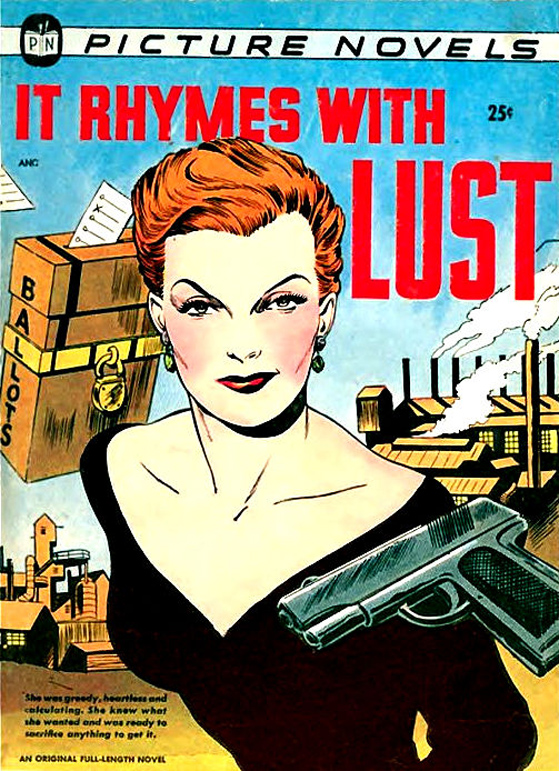
What you see above is basically the literary equivalent of those hieroglyphics that show the ancient Egyptians Egyptian-walking around vases with wavy lines in them. Some people — mostly crazypantses whose job descriptions include -ologists that you’ve never heard of before — say these wavy line vases are proof that the old pharaohs had light bulbs with working filaments. But, as we know, if you didn’t patent it, push it and popularize it, you don’t get to claim it. So sorry, Egyptians, but most of use are just going to assume that your “light bulbs” are actually jar-shaped snakehouses, probably in tribute to some god whose head was one animal and his body was another animal. One these animals may be a snake.
The preceding paragraph exactly describes the curious case of It Rhymes With Lust. EXACTLY. Published in 1950, the book was the first-ever attempt to tell a novel-length story through pictures. Yes, it’s considered the first graphic novel, even though Arnold Drake — one half of the duo who wrote Lust — termed the book a “picture novel.” The intended audience was not children but adults — or at least the kind of adults who would enjoy noirish tales of sex, greed, and political corruption. However, these hoped-for readers didn’t take the bait. St. John Publications released another picture novel — The Case of the Winking Buddha, a mystery story — but that would prove to be the last. Not until 1976 did longer comic books start to be widely referred to as “graphic novels,” and they’re still inching toward all-around acceptance in the U.S. today. As the A.V. Club asks in its review of Lust upon its 2007 reissue, where might the genre be today if this false start in 1950 had instead been a success?
Like I said, totally the same deal with the Egyptian snake bulbs and Rhymes With Lust.
It’s interesting to me, this little footnote in the history of comic books, but what I find most tantalizing is not how Lust’s success could have changed the evolution of graphic novels. It’s the cover. Mostly the title. What is the it, exactly, that rhymes with lust? And which of the many rhymes for lust could the title be referring? Crust? Must? Plussed? (The ever-elusive opposite of nonplussed, of course.) Flust? Zizzust? Hippopotamus’d? Given the look of the tan, presumably windblown town in the background, I would presume that the rhyme could be dust. In truth, the thing that rhymes with lust is the name of the story’s femme fatale: Rust Mason. Yes, the story’s epitome of sex and passion is named after the army buddy your grandpa used to go on hunting trips with, before the accident. I don’t want to criticize what is remembered today as a bold literary venture into a genre unknown to U.S. writers and readers, but maybe it would have been more successful if the main female character didn’t share her name with the unfortunate condition of a gardening trowel left out on a wet night. (Left Out on a Wet Night — now there’s a book title! Doris, get creative on the line!)
And yes, by the way, the woman featured on the cover is, in fact, Rust herself. (Given what parts of her are featured, I suppose bust would have been a decent guess, too.) Really, once you look at the woman, the name Rust Mason doesn’t seem so inappropriately unfeminine. She may be linked with lust, at least in someone’s head, but her cropped hair and sharp facial features make her look downright manly. I’m also amused as to what else Matt Baker included on the cover in order to hint at what kind of story It Rhymes With Lust might be: a handgun and a ballot box, hovering magically around Rust’s bust. Personally, I think the whole story seems a lot more appealing if you interpret these images literally. “It Rhymes With Lust is a story about a woman who gets a gun and a ballot box thrown at her moments after she looks directly into the camera while getting her picture taken.” I’d read that. In fact, I think I just did. But I’d also want to have words with whoever threw the ballot box. “Theodore,” I’d begin, even if his name wasn’t Theodore, just to cheese him off, “This is not what we use ballot boxes for. Ballot boxes are not weapons. Guns are weapons. You could learn a lot about weapons from your friend on the other side of Rust, who threw the gun at her. Because guns, Theodore, are weapons.”
To conclude, what I’d like to think is a quote from the It Rhymes With Lust: “But sultry Rust Mason didn’t have to throw guns, not even in a town like Guntoss Gulch, where the streets crawled with the type of miscreants who’d throw their guns at you as clock you in the head with a ballot box. No, Rust Mason threw something else: sex. Which she poured into water balloon and tossed at passersby from her balcony.”
For the record, I would also read a book about a woman who throws sex-filled water balloons.
Comics, previously:
What you see above is basically the literary equivalent of those hieroglyphics that show the ancient Egyptians Egyptian-walking around vases with wavy lines in them. Some people — mostly crazypantses whose job descriptions include -ologists that you’ve never heard of before — say these wavy line vases are proof that the old pharaohs had light bulbs with working filaments. But, as we know, if you didn’t patent it, push it and popularize it, you don’t get to claim it. So sorry, Egyptians, but most of use are just going to assume that your “light bulbs” are actually jar-shaped snakehouses, probably in tribute to some god whose head was one animal and his body was another animal. One these animals may be a snake.
The preceding paragraph exactly describes the curious case of It Rhymes With Lust. EXACTLY. Published in 1950, the book was the first-ever attempt to tell a novel-length story through pictures. Yes, it’s considered the first graphic novel, even though Arnold Drake — one half of the duo who wrote Lust — termed the book a “picture novel.” The intended audience was not children but adults — or at least the kind of adults who would enjoy noirish tales of sex, greed, and political corruption. However, these hoped-for readers didn’t take the bait. St. John Publications released another picture novel — The Case of the Winking Buddha, a mystery story — but that would prove to be the last. Not until 1976 did longer comic books start to be widely referred to as “graphic novels,” and they’re still inching toward all-around acceptance in the U.S. today. As the A.V. Club asks in its review of Lust upon its 2007 reissue, where might the genre be today if this false start in 1950 had instead been a success?
Like I said, totally the same deal with the Egyptian snake bulbs and Rhymes With Lust.
It’s interesting to me, this little footnote in the history of comic books, but what I find most tantalizing is not how Lust’s success could have changed the evolution of graphic novels. It’s the cover. Mostly the title. What is the it, exactly, that rhymes with lust? And which of the many rhymes for lust could the title be referring? Crust? Must? Plussed? (The ever-elusive opposite of nonplussed, of course.) Flust? Zizzust? Hippopotamus’d? Given the look of the tan, presumably windblown town in the background, I would presume that the rhyme could be dust. In truth, the thing that rhymes with lust is the name of the story’s femme fatale: Rust Mason. Yes, the story’s epitome of sex and passion is named after the army buddy your grandpa used to go on hunting trips with, before the accident. I don’t want to criticize what is remembered today as a bold literary venture into a genre unknown to U.S. writers and readers, but maybe it would have been more successful if the main female character didn’t share her name with the unfortunate condition of a gardening trowel left out on a wet night. (Left Out on a Wet Night — now there’s a book title! Doris, get creative on the line!)
And yes, by the way, the woman featured on the cover is, in fact, Rust herself. (Given what parts of her are featured, I suppose bust would have been a decent guess, too.) Really, once you look at the woman, the name Rust Mason doesn’t seem so inappropriately unfeminine. She may be linked with lust, at least in someone’s head, but her cropped hair and sharp facial features make her look downright manly. I’m also amused as to what else Matt Baker included on the cover in order to hint at what kind of story It Rhymes With Lust might be: a handgun and a ballot box, hovering magically around Rust’s bust. Personally, I think the whole story seems a lot more appealing if you interpret these images literally. “It Rhymes With Lust is a story about a woman who gets a gun and a ballot box thrown at her moments after she looks directly into the camera while getting her picture taken.” I’d read that. In fact, I think I just did. But I’d also want to have words with whoever threw the ballot box. “Theodore,” I’d begin, even if his name wasn’t Theodore, just to cheese him off, “This is not what we use ballot boxes for. Ballot boxes are not weapons. Guns are weapons. You could learn a lot about weapons from your friend on the other side of Rust, who threw the gun at her. Because guns, Theodore, are weapons.”
To conclude, what I’d like to think is a quote from the It Rhymes With Lust: “But sultry Rust Mason didn’t have to throw guns, not even in a town like Guntoss Gulch, where the streets crawled with the type of miscreants who’d throw their guns at you as clock you in the head with a ballot box. No, Rust Mason threw something else: sex. Which she poured into water balloon and tossed at passersby from her balcony.”
For the record, I would also read a book about a woman who throws sex-filled water balloons.
Comics, previously:
Wednesday, April 14, 2010
Wakka Wakka... What the?
From the LG logo to Pac-Man with two simple modifications:

The above logo has been in use ever since this South Korea-based company shortened its name from Lucky Goldstar in 1995. Though the Lucky comes from the company’s original name, Lak-Hui Chemical Industrial Corporation, I still want to say that Lucky Goldstar is some Engrish attempt at making a brand name that would create positive associations with English-speakers — as in, like, Lucky Goldstar A+ No. 1 Homerun. Plus Pac-Man.
(Sources: Wikipedia, the “cloudbush” thread)
Previous items of interest from the cloudbush thread:

The above logo has been in use ever since this South Korea-based company shortened its name from Lucky Goldstar in 1995. Though the Lucky comes from the company’s original name, Lak-Hui Chemical Industrial Corporation, I still want to say that Lucky Goldstar is some Engrish attempt at making a brand name that would create positive associations with English-speakers — as in, like, Lucky Goldstar A+ No. 1 Homerun. Plus Pac-Man.
(Sources: Wikipedia, the “cloudbush” thread)
Previous items of interest from the cloudbush thread:
- “Hidden” musical references in Smash Bros. Brawl
- Toad has been flipping us the bird for more than 20 years
- Those aren’t equals signs in the Golden Axe intro
- It sure seems like Sega ripped of the singer from Deee-Lite with Space Channel 5
- Some similarities between Deep Purple’s “April” and music from Legend of Zelda
- A brief smattering of odd sexiness hidden in early video games
- The clouds in Super Mario Bros. are not what they seem
Tuesday, April 13, 2010
So I Liked “Everybody Likes Hugo”
But that doesn’t mean I’m happy about all of tonight’s Hurley-centic Lost. Life-or-death spoiler warning, by the way.
On one hand, I enjoyed this episode because it gave me some needed closure on Libby, that unluckiest of all Losers. Given that we only have so few episodes of Lost left, the odds that Libby will be further fleshed out or will even appear again seem pretty slim. But I’m choosing to be grateful that we finally were given some indication that Libby was not, in fact evil — that she did seem to truly like Hurley and that she wasn’t insinuating herself into his life to, say, steal his money or communicate with ghosts or learn the secret of The Evil Numbers. Instead, the bond between Hurley and Libby seems to be a real one that, like the bond between Desmond and Penny, can shatter illusions and allow both of them a deeper understanding of reality. “Everybody Loves Hugo” gave us that, at least. It did not, however, give us the story behind Libby — why she happened to be in Australia, why she ended up in the loony bin in the regular timeline, or whether she has a last name. But I suppose I can find solace in the fact that Libby and Hurley finally had their picnic date.
But I have to note the unfortunate juxtaposition of Libby figuratively rising from the grave in the same episode in which Ilana was blown to smithereens. Just as we got a glimpse into one character who was killed off before we learned much about her, a similarly mysterious character was taken out of the running. Though I’m sure we will yet see Ilana again, in some form, I’m bothered that the character’s role on the show might have been to babysit some cranky castaways until she finally tells them about how they might succeed Jacob. And that’s it. Boom. Blowed up — in the same way that ol’ Doc Arzt died, no less. With Arzt, it was more of a sight gag — a deserved end for an inept, bumbling character. Ilana, however, was an action hero who seemed better-suited to survival on Four Toe Island. In fact, among the little we know about her was her steadfast devotion to Jacob and that she had been training all her life to do his work. I’m honestly not sure if her being dynamited into oblivion seems more unfair to her or to us viewers, who accepted this new character presuming that she’d be a necessary addition to the show and its plot. She did play an important role in getting the Oceanic Six to return, I suppose, but what else did she add to the show? Was she merely a plot device? Was she bumped off by an evil island that had gotten its use from her or was it the writers who simply hadn’t thought of anything else for her to do?
I am reminded of the underlying sentiment of my little series on the hard luck of the female characters on this show: “Man do the women on Lost ever get screwed over.”
On one hand, I enjoyed this episode because it gave me some needed closure on Libby, that unluckiest of all Losers. Given that we only have so few episodes of Lost left, the odds that Libby will be further fleshed out or will even appear again seem pretty slim. But I’m choosing to be grateful that we finally were given some indication that Libby was not, in fact evil — that she did seem to truly like Hurley and that she wasn’t insinuating herself into his life to, say, steal his money or communicate with ghosts or learn the secret of The Evil Numbers. Instead, the bond between Hurley and Libby seems to be a real one that, like the bond between Desmond and Penny, can shatter illusions and allow both of them a deeper understanding of reality. “Everybody Loves Hugo” gave us that, at least. It did not, however, give us the story behind Libby — why she happened to be in Australia, why she ended up in the loony bin in the regular timeline, or whether she has a last name. But I suppose I can find solace in the fact that Libby and Hurley finally had their picnic date.

But I have to note the unfortunate juxtaposition of Libby figuratively rising from the grave in the same episode in which Ilana was blown to smithereens. Just as we got a glimpse into one character who was killed off before we learned much about her, a similarly mysterious character was taken out of the running. Though I’m sure we will yet see Ilana again, in some form, I’m bothered that the character’s role on the show might have been to babysit some cranky castaways until she finally tells them about how they might succeed Jacob. And that’s it. Boom. Blowed up — in the same way that ol’ Doc Arzt died, no less. With Arzt, it was more of a sight gag — a deserved end for an inept, bumbling character. Ilana, however, was an action hero who seemed better-suited to survival on Four Toe Island. In fact, among the little we know about her was her steadfast devotion to Jacob and that she had been training all her life to do his work. I’m honestly not sure if her being dynamited into oblivion seems more unfair to her or to us viewers, who accepted this new character presuming that she’d be a necessary addition to the show and its plot. She did play an important role in getting the Oceanic Six to return, I suppose, but what else did she add to the show? Was she merely a plot device? Was she bumped off by an evil island that had gotten its use from her or was it the writers who simply hadn’t thought of anything else for her to do?

I am reminded of the underlying sentiment of my little series on the hard luck of the female characters on this show: “Man do the women on Lost ever get screwed over.”
The Q in Question
Is it possible to make a retroactive cameo? The nature of a cameo requires the person making the brief appearance to be notable. Non-famous people making cameos are called “extras” — unless in the context of a struggling actor’s resume, in which case they’re called “diner,” “co-worker,” or “party attendee.” But what if he or she wasn’t famous at the time they made this appearance? But they linger on screen anyway, making them easy to spot after the fact?
This post won’t answer this — nor will it be about movies or actors or people glimpsed before their rocketship ride to fame. No, it’s about video games. (Ha! Caught you, people who don’t give a damn about video games!) And as far as video games go, it’s about a fairly obscure character from the Street Fighter series. He technically debuted in Street Fighter III but nonetheless seems to have made an appearance eight years earlier in a background in Street Fighter II. Weird, no?

Hit the jump for a little story about a mysterious robot named Q.
For a lot of fans, Street Fighter III is the black sheep of the series because it ditched a lot of the characters that made the previous games popular and replaced them with new ones that didn’t quite fit into the notion of Street Fighter. For example, the first incarnation of Street Fighter III lived up to its subtitle, New Generation, by featuring only two characters from previous games: Ryu and Ken. Replacing series regulars like Zangief and Dhalsim were a motley crew that, to many, seemed weird — a little darker, a little more twisted, a little uglier and generally not like the fighters who slugged it out in the Street Fighter II and Street Fighter Alpha games.
Examples:

On the left, Russian mutant Necro; on the right, bi-colored underwear model and big bad Gill.

On the left, peculiarly long-limbed African princess Elena; on the right, one-armed hermit Oro.
Maybe they’re not all that much stranger than, say, a green-skinned, electrified, feral man from Brazil, but it’s all in what you get used to, I guess. The website Fighting Street suggests that the Street Fighter III fighters do fit in with the rest of the crew because all of them — from any Street Fighter, that is — are equally derivative of other pop culture icons. In any case, Capcom may have heard fans’ dissatisfaction with the Street Fighter III line-up and filled the second and third incarnations of the game with some folks who looked a little more familiar. Street Fighter III: Second Impact saw the return of series villain Akuma as well as the introduction of Hugo, a hulking character inspired by an old Final Fight enemy. And Third Strike brought back Chun-Li — the Street Fighter’s main female character and one of the most recognizable female characters in any video game ever.
Chun-Li was not the only addition, however. Alongside a disarmingly tomboyish teen girl, a floppy-haired French hipster, and yet another mutant was Q, an enigmatic man wearing a metal mask and a Dick Tracy coat.


My reaction to this new character: “Hmm. Another weirdo,” shortly followed by “He kind of looks like The Question.” However, Frank Yagami, the guy who runs the website Fighter’s Generation, noticed that Q looked a lot like a character who had appeared in the background of Ken’s stage in the original Street Fighter II as one of the people cheering the fight from the side of a boat.

Granted, the sprite of this background character is not especially detailed, but yeah — it does look like he’s wearing a trench coat and hat similar to Q’s. Furthermore, he also seems to be wearing the mask, though that could result from the lack of detail given to the nobodies cheering in the background. In console ports of Street Fighter II, the character is even more crudely depicted and sometimes even recolored. For example, check out the equivalent from the Super Nintendo version:

Not too Q-ish. But the original sprite from the arcade version does bear a resemblance to Q. So did Capcom make Q playable in Street Fighter III in order to round out the cast with more familiar-seeming characters? Maybe. On one hand, hardly anyone would recognize the Blurry-Faced Man Cheering on a Boat. However, as Yagami theorizes, perhaps the team behind Street Fighter III simply was scouring the backgrounds of previous games and said “Hey, what’s the deal with that guy, anyway?” From there, they could have chosen to flesh the character out, so to speak, and turned an otherwise unimportant background character into a larger part of the Street Fighter mythos. It wouldn’t be unheard of. The visual basis for Dan Hibiki, a character who debuted in Street Fighter Alpha in 1995, initially appeared in concept art for another character, Sagat, back in 1991 — long before the Alpha games were being made.

Given that anyone wearing these clothes would look similar — more or less like an extra in a winter scene in Mad Men — it would be tempting to dismiss the resemblance as coincidental. But it’s noteworthy that Q has no storyline to speak of, really, aside from an ending sequence that suggests that that there’s something to Yagami’s theory. In it, CIA agents are investigating Q and his unexplained appearances at events all over the world:

And it’s particularly teasing that that last image shows Q lurking on a boat that looks a lot like that same one in Ken’s stage.
You’d think the matter would have been clarified in 2008, when Capcom released Super Street Fighter II Turbo HD Remix, a graphically superior version of the final installment of Street Fighter II. However, the Q-looking dude was omitted from the redrawn background.
As of now, Third Strike is Q’s only official appearance. Though Street Fighter III alums Dudley, Ibuki and Makoto made the cut for the newest installment of Street Fighter IV, Q did not. And until he does, the mystery of who or what he is will have to remain just that. Really, who was that masked man?
Street Fighter and thereabouts, previously:
This post won’t answer this — nor will it be about movies or actors or people glimpsed before their rocketship ride to fame. No, it’s about video games. (Ha! Caught you, people who don’t give a damn about video games!) And as far as video games go, it’s about a fairly obscure character from the Street Fighter series. He technically debuted in Street Fighter III but nonetheless seems to have made an appearance eight years earlier in a background in Street Fighter II. Weird, no?
Hit the jump for a little story about a mysterious robot named Q.
For a lot of fans, Street Fighter III is the black sheep of the series because it ditched a lot of the characters that made the previous games popular and replaced them with new ones that didn’t quite fit into the notion of Street Fighter. For example, the first incarnation of Street Fighter III lived up to its subtitle, New Generation, by featuring only two characters from previous games: Ryu and Ken. Replacing series regulars like Zangief and Dhalsim were a motley crew that, to many, seemed weird — a little darker, a little more twisted, a little uglier and generally not like the fighters who slugged it out in the Street Fighter II and Street Fighter Alpha games.
Examples:
On the left, Russian mutant Necro; on the right, bi-colored underwear model and big bad Gill.
On the left, peculiarly long-limbed African princess Elena; on the right, one-armed hermit Oro.
Maybe they’re not all that much stranger than, say, a green-skinned, electrified, feral man from Brazil, but it’s all in what you get used to, I guess. The website Fighting Street suggests that the Street Fighter III fighters do fit in with the rest of the crew because all of them — from any Street Fighter, that is — are equally derivative of other pop culture icons. In any case, Capcom may have heard fans’ dissatisfaction with the Street Fighter III line-up and filled the second and third incarnations of the game with some folks who looked a little more familiar. Street Fighter III: Second Impact saw the return of series villain Akuma as well as the introduction of Hugo, a hulking character inspired by an old Final Fight enemy. And Third Strike brought back Chun-Li — the Street Fighter’s main female character and one of the most recognizable female characters in any video game ever.
Chun-Li was not the only addition, however. Alongside a disarmingly tomboyish teen girl, a floppy-haired French hipster, and yet another mutant was Q, an enigmatic man wearing a metal mask and a Dick Tracy coat.
My reaction to this new character: “Hmm. Another weirdo,” shortly followed by “He kind of looks like The Question.” However, Frank Yagami, the guy who runs the website Fighter’s Generation, noticed that Q looked a lot like a character who had appeared in the background of Ken’s stage in the original Street Fighter II as one of the people cheering the fight from the side of a boat.
Granted, the sprite of this background character is not especially detailed, but yeah — it does look like he’s wearing a trench coat and hat similar to Q’s. Furthermore, he also seems to be wearing the mask, though that could result from the lack of detail given to the nobodies cheering in the background. In console ports of Street Fighter II, the character is even more crudely depicted and sometimes even recolored. For example, check out the equivalent from the Super Nintendo version:
Not too Q-ish. But the original sprite from the arcade version does bear a resemblance to Q. So did Capcom make Q playable in Street Fighter III in order to round out the cast with more familiar-seeming characters? Maybe. On one hand, hardly anyone would recognize the Blurry-Faced Man Cheering on a Boat. However, as Yagami theorizes, perhaps the team behind Street Fighter III simply was scouring the backgrounds of previous games and said “Hey, what’s the deal with that guy, anyway?” From there, they could have chosen to flesh the character out, so to speak, and turned an otherwise unimportant background character into a larger part of the Street Fighter mythos. It wouldn’t be unheard of. The visual basis for Dan Hibiki, a character who debuted in Street Fighter Alpha in 1995, initially appeared in concept art for another character, Sagat, back in 1991 — long before the Alpha games were being made.
Given that anyone wearing these clothes would look similar — more or less like an extra in a winter scene in Mad Men — it would be tempting to dismiss the resemblance as coincidental. But it’s noteworthy that Q has no storyline to speak of, really, aside from an ending sequence that suggests that that there’s something to Yagami’s theory. In it, CIA agents are investigating Q and his unexplained appearances at events all over the world:
And it’s particularly teasing that that last image shows Q lurking on a boat that looks a lot like that same one in Ken’s stage.
You’d think the matter would have been clarified in 2008, when Capcom released Super Street Fighter II Turbo HD Remix, a graphically superior version of the final installment of Street Fighter II. However, the Q-looking dude was omitted from the redrawn background.


As of now, Third Strike is Q’s only official appearance. Though Street Fighter III alums Dudley, Ibuki and Makoto made the cut for the newest installment of Street Fighter IV, Q did not. And until he does, the mystery of who or what he is will have to remain just that. Really, who was that masked man?
Street Fighter and thereabouts, previously:
Subscribe to:
Posts (Atom)