
Tuesday, December 29, 2009
Same Actor, Same Role, Different Language
Gérard Depardieu played what is essentially the same role in the 1991 French movie Mon père, ce héros and its 1994 remake, My Father the Hero. And Penelope Cruz played what is essentially the same role in the 1997 Spanish film Abre los ojos and its 2001 remake, Vanilla Sky. These are the only two incidents I can think of in which an actor appeared in the same role in both a movie and its remake, barring those appearing in short films that were ultimately allowed to grow to feature-length ones. Can anyone else think of actors who have done this? I’m sure I’ve heard of others and I’m sure there are many I’ve never heard of. Please inform me if you know of any.

Sunday, December 27, 2009
At the Bottom of Night
Sleepy time for the Chrono Trigger crew in a poster I received with my copy of the game.

For the diehards: the other poster.
For the diehards: the other poster.
Wednesday, December 23, 2009
The Timberdrake
A promo poster that arrived with my copy of Secret of Evermore

If only the game had been as good as this stained glass design. Oh well — nostalgia nonetheless. Again, excuse the pinholes and tears, as this too spent some time on my bedroom wall.
If only the game had been as good as this stained glass design. Oh well — nostalgia nonetheless. Again, excuse the pinholes and tears, as this too spent some time on my bedroom wall.
Saturday, December 19, 2009
With Their Noses High in the Air
It being so close to Christmas — and this post likely being the last word-of-the-week one before December 25 comes and goes — you’d think I’d try to find something holiday-related to put up. No such luck. I won’t be regurgitating the story behind mistletoe or nog or poinsettia. Instead, I’ll just be sharing with you a word that I just recently learned and thought was cool, if only as a means of saying three syllables what might otherwise need more.
This is why nosism might be practiced by monarchs or the monarch-minded, since they would have reason to keep up the appearance of being authoritative or, as the Wikipedia page on pluralis majestatis notes, speaking on behalf of the whole country. And this is also why a newspaper editorial might be written in the plural first person, even if the text itself is typed out by just one guy: to give what’s written the weight of the entire editorial board. The trouble is, of course, that anyone with a brain is wise to this practice, so rather than making the we-speaker seem like a bigger deal, he just seems like a bigger dick, especially when taken out of the royal and newspaper contexts. It’s also noted on the Wikipedia page that we can also be used in an educational sense — “If we add three plus three, we get six.” — and a patronizing one — “How are we feeling today?” as a doctor might ask —
As noted on A.Word.A.Day, nosism comes from the Latin nos, meaning “we.” Whee.
Previous words of the week:
nosism (NOS-iz-em) — noun: the use of we in referring to oneselfAlso known as the royal we, the editorial we or the stuck-up jerkass we, the use of the this plural pronoun by an entity that’s more on the singular side — that is, too wee to be a we — seems like something you’d do to make yourself seem more powerful. The opinion of just a me is one thing, but the shared opinion of an us is a bit more threatening.
This is why nosism might be practiced by monarchs or the monarch-minded, since they would have reason to keep up the appearance of being authoritative or, as the Wikipedia page on pluralis majestatis notes, speaking on behalf of the whole country. And this is also why a newspaper editorial might be written in the plural first person, even if the text itself is typed out by just one guy: to give what’s written the weight of the entire editorial board. The trouble is, of course, that anyone with a brain is wise to this practice, so rather than making the we-speaker seem like a bigger deal, he just seems like a bigger dick, especially when taken out of the royal and newspaper contexts. It’s also noted on the Wikipedia page that we can also be used in an educational sense — “If we add three plus three, we get six.” — and a patronizing one — “How are we feeling today?” as a doctor might ask —
As noted on A.Word.A.Day, nosism comes from the Latin nos, meaning “we.” Whee.
Previous words of the week:
- adulterine, ageusia, ambeer, anosmia
- barrack, bissextile, breastsummer
- catholicon, cecaelia, couvade, cranberry morpheme, cummingtonite
- deasil, decussate
- eidolon, epeolatry, epopt, espalier
- fabiform, fissilingual
- gallinipper, grandgore
- hippopotomonstrosesquipedaliophobia, honorificabilitudinitatibus
- itaiitai, ignivomous
- jamais vu, jehu, jumentous
- kaffir, kakopygian, knipperdollin
- leman, lemniscate, limnovore, linsey-woolsey, longicorn
- malacia, milt, mongo
- nihilartikel, nobiliary particle
- ooglification, orchidectomy, ordured, orf
- pareidolia, pavonted, petrichor, pismire, pong, puggle, purse
- quacksalver, quagga, qualtagh, quidnunc
- ronion, roynish, rubirosa
- salmagundi, scrutator, seneschal, shebang, sinople, stevedore
- tergiversate, thon, tiffin, tittery-whoppet, toby, tyro
- ucalegon, ultramontane
- veneficial, verdigris, vespertilionine, vinegeroon
- williwaw, witzelsucht
- xenodocheionology, xyster
- yazoo, ypsiliform, yoink
- zanjero, zenzizenzizenzic, zinnober, zugzwang
Friday, December 18, 2009
Questions Posed to the Hard-to-Shop-for Gift Recipient
“You have Netflix already, right?”
“Oh, well, have you already purchased that coat you had your eye on?”
“Model train set? Yes?”
“Okay then, do you already own heirloom chickens, by any chance?”
“And would you have any interest in owning a vintage cricket uniform?”
“Are you lacking at all in the ninja star department?”
“Why would you think these are strange questions for me to be asking?”
“Well, now that that’s behind us, have you ever felt like your life would be better if Toni Basil choreographed a hip hopera based on your life?”
“What about pickles? Do you like pickles? Because I am pretty close to just buying you an economy jar of Vlasic dill spears? Is that what you want? A gallon of dill spears?”
“Oh, well, have you already purchased that coat you had your eye on?”
“Model train set? Yes?”
“Okay then, do you already own heirloom chickens, by any chance?”
“And would you have any interest in owning a vintage cricket uniform?”
“Are you lacking at all in the ninja star department?”
“Why would you think these are strange questions for me to be asking?”
“Well, now that that’s behind us, have you ever felt like your life would be better if Toni Basil choreographed a hip hopera based on your life?”
“What about pickles? Do you like pickles? Because I am pretty close to just buying you an economy jar of Vlasic dill spears? Is that what you want? A gallon of dill spears?”
Thursday, December 17, 2009
The Second Truth From the Left
Scanned: The poster of Secret of Mana.

A thought: What the hell was the secret being referred to in the game’s title?

A thought: What the hell was the secret being referred to in the game’s title?
Wednesday, December 16, 2009
Who Put the “P” in the P-Wing?
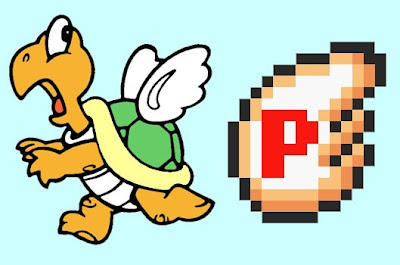
Like many kids, I played Super Mario Bros. 3 until my fingers hurt. During all that time spent in front of a television sent, fingers a-twiddling, I had an opportunity to think. One of the things that has bugged me about that game is a very special item called the P-Wing that allowed Mario to fly over a given stage, avoiding injury and the certain death that bottomless pits bring. But why was it called P-Wing? What does that “P” stand for?
These are questions that seemed quite pressing to a child. Now, as a 27-year-old, I’ve finally gotten the answer. (Though I kind of forgot I was looking for this answer for roughly seventeen years. So there’s that.) Wii.com has a regular feature called Iwata Asks, in which Nintendo president Satoru Iwata talks to the people who develop Nintendo games and has them walk him through the history of a given franchise or staple video game element. It’s basically as close to director’s commentary as video games can get. The release of New Super Mario Bros. Wii last month prompted a discussion on the history of the Mario franchise that yielded some cool tidbits, including that Mario’s creator, Shigeru Miyamoto, initially wanted to call him Mr. Video and that the Goombas — those ambulatory mushrooms, quietly villainous and so easily stomped — are, in fact, shitakes. (That latter bit might be kind of a “no duh” to anyone with eyes and a basic understanding of what mushrooms look like, but the Japanese name for the critter translates more or less to “chestnut people,” leading some to think they were chestnuts with legs. Chestnuts with legs! The insanity of it!)
I might not have even had a look at these interviews had I not seen a tip-off at game blog Destructoid, which noted that the P-Wing was to Super Mario Bros. 3 what a new function called the Super Guide is to New Super Mario Bros. Wii: a means of helping unskilled players clear difficult levels and proceeding with the game. For the former, it allowed them to flit right over the hard parts. For the latter, it allows the computer to play through the level, demonstrating how to clear obstacles.
Destructoid didn’t note it, but the article also answered how the P-Wing, this item for baby players with clumsy little starfish hands got its name. Nintendo veteran Toshihiko Nakago is explaining the physics of flying in Super Mario Bros. 3 — which, by the way, involves a raccoon tail and ears, just like we now use today — and how normally Mario would need to get a good running start before he could take off.
The funny thing about the “P” behind the P-Wing is that it’s probably a coincidence that this explanation of its name ended up working out sensibly in English. In Japan, the Paratroopa is called Patapata, which comes from the Japanese onomatopoeia for a pattering noise — usually of feet but apparently in this case for the flapping of wings. It just so happens, then, that the Japanese and English names for this thing happen to start with the same letter. The rest of the characters’ Japanese and English names don’t, by the way, and those translating the original game clearly didn’t take initial letters into account when they dreamed up English-friendly names for the characters.
Regardless, that settles that about that “P.” Eight-year-old me would be so satisfied. Current me: slightly less so, I suppose, but happy nonetheless.
So… What, then, does the “P” on the balloon power-up in Super Mario World stand for?
These are questions that seemed quite pressing to a child. Now, as a 27-year-old, I’ve finally gotten the answer. (Though I kind of forgot I was looking for this answer for roughly seventeen years. So there’s that.) Wii.com has a regular feature called Iwata Asks, in which Nintendo president Satoru Iwata talks to the people who develop Nintendo games and has them walk him through the history of a given franchise or staple video game element. It’s basically as close to director’s commentary as video games can get. The release of New Super Mario Bros. Wii last month prompted a discussion on the history of the Mario franchise that yielded some cool tidbits, including that Mario’s creator, Shigeru Miyamoto, initially wanted to call him Mr. Video and that the Goombas — those ambulatory mushrooms, quietly villainous and so easily stomped — are, in fact, shitakes. (That latter bit might be kind of a “no duh” to anyone with eyes and a basic understanding of what mushrooms look like, but the Japanese name for the critter translates more or less to “chestnut people,” leading some to think they were chestnuts with legs. Chestnuts with legs! The insanity of it!)
I might not have even had a look at these interviews had I not seen a tip-off at game blog Destructoid, which noted that the P-Wing was to Super Mario Bros. 3 what a new function called the Super Guide is to New Super Mario Bros. Wii: a means of helping unskilled players clear difficult levels and proceeding with the game. For the former, it allowed them to flit right over the hard parts. For the latter, it allows the computer to play through the level, demonstrating how to clear obstacles.
Destructoid didn’t note it, but the article also answered how the P-Wing, this item for baby players with clumsy little starfish hands got its name. Nintendo veteran Toshihiko Nakago is explaining the physics of flying in Super Mario Bros. 3 — which, by the way, involves a raccoon tail and ears, just like we now use today — and how normally Mario would need to get a good running start before he could take off.
I’m not sure who came up with the name, but we all referred to this as “the runway.” So at that point, we looked again at the maps and completely reworked the levels so that Mario would have places where he could take off from. In the end, we made it so that if you got an item called the P-Wing, which was the Koopa Paratroopa’s wing, you could fly through the whole level.So there you go. The item — a wing with an otherwise mysterious “P” on it — comes from the Paratroopa enemy, hence the initial. The Koopa Paratroopa — a winged turtle whose name is a pretty obvious pun on paratrooper — has been airborne ever since the original Super Mario Bros., and it’s his wing that makes the P-Wing-powered Mario so ready for flight… even though he’s still flying with raccoon parts.

The funny thing about the “P” behind the P-Wing is that it’s probably a coincidence that this explanation of its name ended up working out sensibly in English. In Japan, the Paratroopa is called Patapata, which comes from the Japanese onomatopoeia for a pattering noise — usually of feet but apparently in this case for the flapping of wings. It just so happens, then, that the Japanese and English names for this thing happen to start with the same letter. The rest of the characters’ Japanese and English names don’t, by the way, and those translating the original game clearly didn’t take initial letters into account when they dreamed up English-friendly names for the characters.
Regardless, that settles that about that “P.” Eight-year-old me would be so satisfied. Current me: slightly less so, I suppose, but happy nonetheless.
So… What, then, does the “P” on the balloon power-up in Super Mario World stand for?
Subscribe to:
Posts (Atom)