Rules:And be forewarned: I tend to have fairly odd taste in music. Make of that what you will.
1. You guys tell me what kind of music you want.
2. In a few days, I'll post one mp3 for each of you.
You can't request music by band name or genre. You have to describe, in terms of color, mood, texture, taste, or any other creative way you can think of, what you're looking for in a song, and I'll do the best I can with what I have. Yes, that means that I may end up posting a song that you wouldn't normally listen to. That's part of the fun.
I can't use more than one song by any given band. The point of this meme is to give you a taste of new stuff, not to pirate whole CDs. If you like what you hear, you'll still need to buy it yourself. If two of you come up with identical descriptions, I have to find two bands that both fit, or use one song for both of you.
I can't make the song permanently available. Unless the song in question is already available on the band's website (in which case, I'll provide a link to their site instead of posting an mp3), I'll be taking the songs down in a few days, or posting them on a temporary host so that they'll expire after a few days.

Wednesday, October 4, 2006
Fun Teenager Ketchup Party
Stole it from Meg H., who stole it from Bri. It really did sound like fun:

Monday, October 2, 2006
Antonio Carlos Showbeam
Still too busy for words. In the meantime, play with this neat little reflected bird. He's fun, I swear.

Thursday, September 28, 2006
Made for the Minds of Children
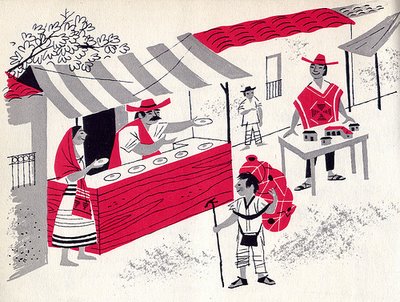
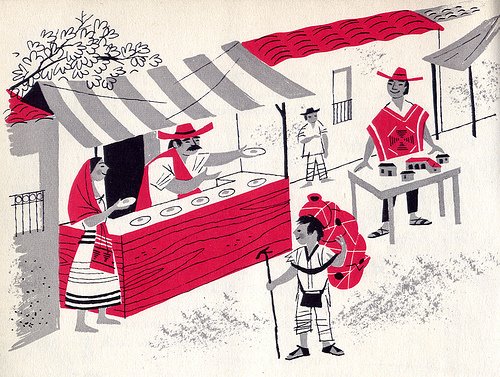
Three rather nice images that some nice person scanned from their old children's books. Presenting a Mexican marketplace:
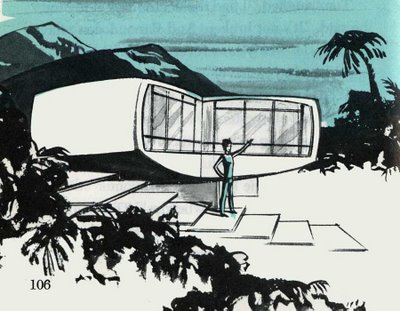
The house of the future:
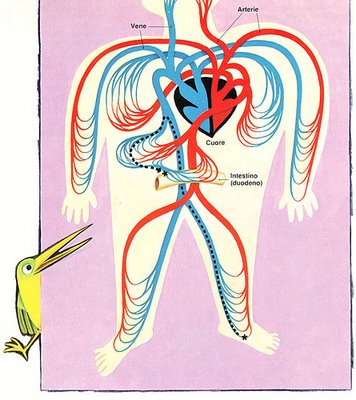
And your circulatory system, as explained by an Italian canary:
The house of the future:

And your circulatory system, as explained by an Italian canary:

Tuesday, September 26, 2006
The Minus World
A large part of why I started to like video games as a child stems from the strange features that these Japanese-created pieces of software sometimes presented. Often, the simple eight-bit graphics presented visual ambiguities that my little mind couldn’t comprehend. For example, at the end of a level in the original Super Mario Bros., what was that design on the flag supposed to be? A mushroom? A peace sign? A skull? I never knew. But I’d notice these little things and my curiosity would suck me into the world of these games — however pixilated their presentation — and I’d be hooked.
A prime example of this was the Minus World. For the uninitiated, the Minus World is a glitch in the original Super Mario Bros that, with some finesse, could sneak Mario into a glitch level. (Level in this game are named “1-1,” “1-2,” “3-3,” “3-4,” etc., all the way to the final level, “8-4.” The so-called Minus World, however, didn’t display the first digit. Instead, the level name was displayed “-1,” which looked like “negative one,” hence the term “Minus World.”) Once there, the level didn’t really present anything all that spectacular: only an endless underwater stage that players could send poor Mario through over and over again, until the timer ran out and he died. At the time, however, I had no reason to suspect anything other than that the Minus World was a deliberate secret that developers put in the game, and that there was some important meaning behind it.
There wasn’t, of course, but the idea intrigued me nonetheless.
Today, the gaming blog Kotaku posted this video of an alternate version of the Minus World, from the Japanese Famicom Disk System version of Super Mario Bros. As Kotaku notes, it’s all the more surreal. Seeing this today made me feel once again like the awestruck little kid that first stumbled into the Minus World so many years ago.
A prime example of this was the Minus World. For the uninitiated, the Minus World is a glitch in the original Super Mario Bros that, with some finesse, could sneak Mario into a glitch level. (Level in this game are named “1-1,” “1-2,” “3-3,” “3-4,” etc., all the way to the final level, “8-4.” The so-called Minus World, however, didn’t display the first digit. Instead, the level name was displayed “-1,” which looked like “negative one,” hence the term “Minus World.”) Once there, the level didn’t really present anything all that spectacular: only an endless underwater stage that players could send poor Mario through over and over again, until the timer ran out and he died. At the time, however, I had no reason to suspect anything other than that the Minus World was a deliberate secret that developers put in the game, and that there was some important meaning behind it.
There wasn’t, of course, but the idea intrigued me nonetheless.
Today, the gaming blog Kotaku posted this video of an alternate version of the Minus World, from the Japanese Famicom Disk System version of Super Mario Bros. As Kotaku notes, it’s all the more surreal. Seeing this today made me feel once again like the awestruck little kid that first stumbled into the Minus World so many years ago.

Tuesday, September 19, 2006
To Buffalo
This morning, the righteous Dina sent me a link to the Wikipedia page for a certain linguistic parlor trick. “I'm sure you've seen this and probably blogged about it, but it makes
me happy, and I would like to share,” she said. In fact I had not heard of this, but Dina nailed it on the head when she decided it was something worth sharing.
Generally credited to William J. Rapaport, an associate professor at the University of Buffalo, the following sentence is grammatically correct, at least in a technical sense.
In my mind, the sentence should have either read
The Wikipedia article also suggest others, including "Badgers badgers badger badger badgers." but I don't even want to attempt delving into those today. All of them, however, are what is known as "garden path sentences" — that is, a sentence you can't correctly understand without doubling back and re-reading. "The horse raced past the barn fell," for another example, in case your head doesn't hurt like mine.
And it's with no small sense of humor that I note "buffalo" can also mean "to confuse." Seriously, who thought "buffalo" was suitable to being a real word, anyway?
me happy, and I would like to share,” she said. In fact I had not heard of this, but Dina nailed it on the head when she decided it was something worth sharing.
Generally credited to William J. Rapaport, an associate professor at the University of Buffalo, the following sentence is grammatically correct, at least in a technical sense.
“Buffalo buffalo Buffalo buffalo buffalo buffalo Buffalo buffalo.”Technically correct, of course, is the best kind of correct. It describes the social hierarchy of buffalos at the Buffalo Zoo in Buffalo, New York. It employs three definitions for the word “buffalo”: the animal, the place and the verb meaning “to intimidate.” (Also, I should note that this is one verb I neglected to list in the post regarding animal name verbs, “Don’t Make Me Platypus All Over You.”) Translated into easier words, the sentence is trying to relate the fact that some buffaloes from the Buffalo Zoo that other buffaloes intimidate themselves also like to intimidate a third group of buffaloes in the zoo. Initially the sentence was problematic to me, even with the explanation. I kept feeling that any way I read it, the sentence omitted a crucial “that” whose presence grammar demanded.
In my mind, the sentence should have either read
Buffalo buffalo that buffalo buffalo buffalo Buffalo buffalo.or
Buffalo buffalo buffalo buffalo that buffalo Buffalo buffalo.
Then i realized I was leaving out one "buffalo." Furthermore, neither of these interpretations really express what the sentence should, however, and I had to read the Wikipedia’s explanation of it several times in order to get it. Even still, the correct interpretation fades out of my head the instant I avert my attention to anything else, kind of like how you can work to see the alternate interpretation in an optical illusion, but then revert back to the initial image if you stop concentrating and then have to work back to the secondary one. A major clue is which words are capitalized, as you can tell those words have to be the city, excluding the first one, of course.
To explain, I’m going to employ so font modifications. In the below sentence the bold buffalo represents the city name, the italicized buffalo represents the animal and the plain one represents the verb.Buffalo buffalo Buffalo buffalo buffalo buffalo Buffalo buffalo.This, to me, is the easiest way to parse the sentence. Think of every "Buffalo buffalo," with the capitalized one followed by the lower-case one, as "a group of buffalos from the city Buffalo." With that, you have
Various buffalo at the Buffalo zoo that other buffalo at the same zoo tend to intimidate in turn go and treat this third group of buffalo at the zoo in a similar way.or
[One group of] Buffalo buffalo [that other] Buffalo buffalo [tend to] buffalo [themselves] buffalo [other] Buffalo buffalo.or
Buffalo buffalo Buffalo buffalo buffalo buffalo Buffalo buffalo.It's like making algebra out of grammar, which you'd think I hate but apparently don't. Still, I can't believe I've typed the word "buffalo" this many times. Likely, more than a lot of people have in their lives, rather than Buffalo Bill. I can no longer even look at the word "buffalo" without thinking that it now looks wrong, just by virtue of me having stared at it for so long and noticing how weird it is.
The Wikipedia article also suggest others, including "Badgers badgers badger badger badgers." but I don't even want to attempt delving into those today. All of them, however, are what is known as "garden path sentences" — that is, a sentence you can't correctly understand without doubling back and re-reading. "The horse raced past the barn fell," for another example, in case your head doesn't hurt like mine.
And it's with no small sense of humor that I note "buffalo" can also mean "to confuse." Seriously, who thought "buffalo" was suitable to being a real word, anyway?
[ link: Wikipedia on "garden path sentences" ]
Saturday, September 16, 2006
The Kendall Effect
If there’s one thing I love more than self-referencing TV shows, it’s self-referencing TV shows that references other self-referencing TV shows.

Case in point: the Kendall effect. Before Sarah Michelle Gellar became the girl who spends her time running from or after various supernatural terrors, she had a two-year stint on All My Children as Kendall Hart, the scheming long-lost daughter of the Susan Lucci character. I never saw her in action, but Gellar apparently won a Daytime Emmy for her performance. Years later, Gellar was on Buffy, where she frequently butted heads with Cordelia Chase, the snobby cheerleader character played by Charisma Carpenter. Cordelia was often aided in her efforts to make Buffy feel bad by her cohort, Harmony, who was played by Mercedes McNab. Despite her vapidness, Harmony is actually the longest-lived character in the Buffy universe. She appears in both the original unaired half-hour pilot for the show and the series finale of Angel, the spin-off in which she appeared as a regular during the last season. Midway through her run, however, Buffy’s gang goes searching for Harmony, using their senior yearbook as an identifying photo. There, viewers saw for the first time that Harmony’s last name was, in fact, Kendall. Knowing Joss Whedon’s pop culture savvy, I have to believe the reference is intentional, especially given that Gellar’s soap opera work is what landed her the title role to begin with.
That brings us up to the present, with me watching too much Veronica Mars. In the most recent season, Veronica clashed with a new character, played by Charisma Carpenter. The scheming step-mother of two of Veronica’s classmates, the character’s name was Kendall Casablancas — which, by the way, would be a great soap opera name. Seeing as how series creator Rob Thomas — no, not that one — has a propensity for referencing the other great TV shows of our day — there’s an episode featuring George Michael and Maebe from Arrested Development, for example, and another one featuring the cursed numbers from Lost and another in which Joss Whedon himself actually appears — I have to again believe that the presence of this name is no accident. In fact, this name seems to have traced through three TV shows and each time attached to attractive, minorly villainous women.
And things like that make watching TV fun.

Case in point: the Kendall effect. Before Sarah Michelle Gellar became the girl who spends her time running from or after various supernatural terrors, she had a two-year stint on All My Children as Kendall Hart, the scheming long-lost daughter of the Susan Lucci character. I never saw her in action, but Gellar apparently won a Daytime Emmy for her performance. Years later, Gellar was on Buffy, where she frequently butted heads with Cordelia Chase, the snobby cheerleader character played by Charisma Carpenter. Cordelia was often aided in her efforts to make Buffy feel bad by her cohort, Harmony, who was played by Mercedes McNab. Despite her vapidness, Harmony is actually the longest-lived character in the Buffy universe. She appears in both the original unaired half-hour pilot for the show and the series finale of Angel, the spin-off in which she appeared as a regular during the last season. Midway through her run, however, Buffy’s gang goes searching for Harmony, using their senior yearbook as an identifying photo. There, viewers saw for the first time that Harmony’s last name was, in fact, Kendall. Knowing Joss Whedon’s pop culture savvy, I have to believe the reference is intentional, especially given that Gellar’s soap opera work is what landed her the title role to begin with.
That brings us up to the present, with me watching too much Veronica Mars. In the most recent season, Veronica clashed with a new character, played by Charisma Carpenter. The scheming step-mother of two of Veronica’s classmates, the character’s name was Kendall Casablancas — which, by the way, would be a great soap opera name. Seeing as how series creator Rob Thomas — no, not that one — has a propensity for referencing the other great TV shows of our day — there’s an episode featuring George Michael and Maebe from Arrested Development, for example, and another one featuring the cursed numbers from Lost and another in which Joss Whedon himself actually appears — I have to again believe that the presence of this name is no accident. In fact, this name seems to have traced through three TV shows and each time attached to attractive, minorly villainous women.
And things like that make watching TV fun.
A Wild Butterfly
I'm shocked — shocked — to know that the 80s hit "Obsession" is not, in fact, by Human League, as I've long thought. The song was actually song by the band Animotion, whose lead singer, Michael Des Barres, later had a son who started what was once my favorite publication: Diehard Gamefan.
Weird what Wikipedia teaches you.
Weird what Wikipedia teaches you.
Subscribe to:
Posts (Atom)