Pages

Showing posts with label LACMA. Show all posts

Saturday, February 18, 2012

Another Catholic Nightmare

So I got bored. Voila! That’s how gifs are made!

Photobucket 

My LACMA Catholic nightmare — snapped, shopped and now finally giffed. I am pleased for having attained a skill already mastered by junior high school students.

Thursday, February 9, 2012

Two Cinematic, Catholic Nightmares

It took place at LACMA, while I was awake. And while technically it occurred only in the space between these statues and the camera, but that doesn’t make it seem any less sinister, I say.


What with the monks and the rampant Catholicism, it could also be a Dario Argento nightmare. Here, let me make a few alterations.


There. Now you’re dreaming in all the colors of the night.

Monday, June 28, 2010

Super Mario Abstract

It began with LACMA, it began with Kandinsky, but — oh, yes, that’s right, I realize now — it really began with Emil Nolde. I saw these amazing postcards at LACMA. Nolde had painted anthropomorphic versions of famous European mountains, but the postcards are rare enough that digitized versions simply don’t exist online, at least where I was looking. Then, somehow, I ended up on this page and found a certain painting — allegedly something called “At Rest,” allegedly by Mr. Wassily Kandinsky.


Instantly, briefly, this painting of mysterious origin became my whole world: Was it just me, or did it look eerily like a stage from a Super Mario Bros. game? Am I the only one who would see this similarity? Could the Super Mario aesthetic, in fact, be an intentional homage to Kandinsky? Consider the geometric qualities of the “hills” and “trees.” Consider the odd assemblage of polygons on either side, some overlapping others to suggest that they extend into the background. Consider the “structures” floating against the background, perhaps suggesting motion but perhaps also meant to be solid objects inexplicably suspended in the air. There’s definitely something in this painting that the old Mario games echoed, intentionally or not.

Points in favor of “not”: First off, I tend to see Mario where no Mario exists. More to the point, Kandinsky (or whoever did the above painting) was doing an abstract landscape, letting basic shapes stand in for the features that would normally decorate a given stretch of land. Similarly, the Nintendo people had to create similar terrain in making Mario games — especially Super Mario Bros. 3 and Super Mario World — mostly as a result of the technical limitations of the systems for which they were designing games. It could very well be that a staggered collection of quadrangles is just that, whether in a early twentieth-century painting or in a late twentieth-century Nintendo game.

Still, the resemblance jumps out to someone like me, who likes art but has spent too much time with a video game controller in his hands and will therefore be likely to fuse the two interests into one. I was curious about what other abstract Kandinsky landscapes might look like and looked around online. What I turned up supports at least the simplest conclusion: that there is, in fact, a visual similarity between these paintings and Mario games.

“the great gate of kiev” (1928)

“softened construction” (1927)

“brownish” (1931)
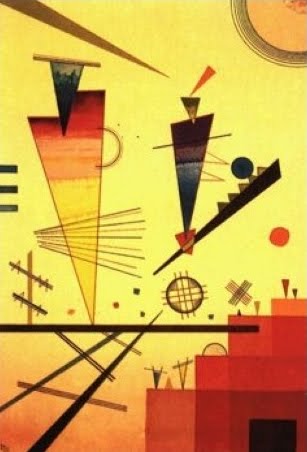
“structure joyeuse” (1928)

“composition eight” (1923)

As the paintings get weirder and more surreal, they look particularly like the Wii game Super Paper Mario, a work of art in its own right that forces two-dimensional figures into a three-dimensional world (both in terms of graphics and the game’s plot) and which folds surreal art into a platform game universe. I know most people who read this blog haven’t played Super Paper Mario, but it’s a sight to behold, particularly Flipside, a geometric city that serves as the game’s “portal,” through which the various stages are accessed. (I tried to find appropriate art from the game to post here but found no usable screenshots online.) Looking at these paintings, I can see echoes of them in the game — Flipside especially.

In poking around at art websites, I also stumbled upon an Emil Nolde — not the one that I was originally looking for, but one that looked weirdly like one of the bad guys from Super Paper Mario. It’s a coincidence, I’m sure, but a noteworthy one, given my thought process leading up to it.
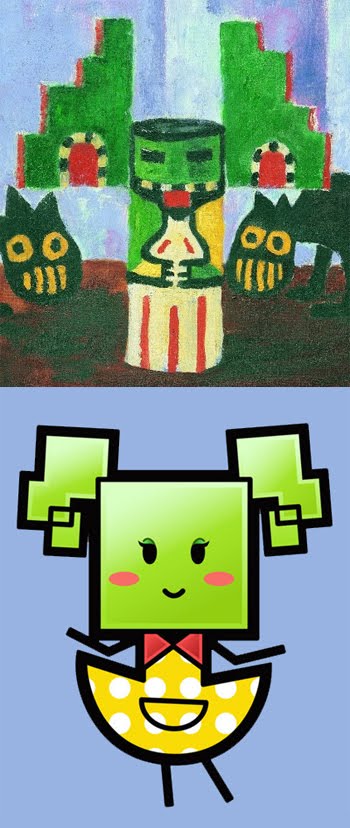


I conclude nothing from all this, but I will at least point out that one of the few goals I’d like to accomplish with this blog is to elevate video games as a medium. A lot of people look down of them, even today. They may not see the place of video games in the greater cultural context. A connection like this, however, at least hints that such a connection might be possible — that there could possibly be a connection between the art hung in museums and the games played in our living rooms.

Mario, previously:

Wednesday, May 5, 2010

A Single-Sided Kandinsky

This is a Wassily Kandinsky print that I saw at LACMA. I’m not sure of the title, the date the original was made or the date this particular print was made, but I’m kind of obsessed with it.


Something about the those reds and blues — the way they seem to mimic mid-century commercial art and packaging makes me all the more interested in what’s going on here.

That is all.

Sunday, May 2, 2010

Do You Need Some Tweezers to Put That Thing Away?

Another from the LACMA trip. Apologies to the easily offended, but my sense of humor never really evolved beyond the sixth-grade level, especially in contexts where I’m expected to act intelligent, polite or in some other way grown-up. But can I please be forgiven for finding Guido Reni’s Bacchus and Ariadne suggestive and therefore hilarious?


Seriously, look at the position and pose of Ariadne’s right hand. Then look at her facial expression. That’s not coyness. That’s not curiosity. That’s boredom bordering on revulsion. And then look at Bacchus. Look at it. Just look. Could this really be interpreted by any viewer in any time period differently? Or, at least, would viewers in 1620 have been able to interpret it in the way I am? Could Reni have not anticipated how his depiction of this interaction could be open to interpretation?

Saturday, May 1, 2010

Ain’t It a Nef?

Things you learn at LACMA: Art is neat. The museum grows every time you avert your eyes from it. And there’s a Paul Klee painting of a pear that, when viewed from the right angle, seems to contain a hidden image of the Virgin Mary in style of the Gelflings from The Dark Crystal. Also, if you are me, you learn the word of the week.
nef (pronounced just like you’d think) — noun: an ornamental vessel used for the decoration of the table, having a form resembling a ship of the Middle Ages.
I cam across nef at LACMA on the placard attached to this item:


Certainly decorative. Clearly boat-shaped. Also, fragile enough that I should never adorn the tables of diners prone to emphatic hand gestures. This word does not have a particularly convoluted etymology. Most sources simply cite that it comes from the French nef, “ship,” which in turn comes from the Latin navis, the Greek naus and all the way back to the Proto Indo-European root nāu-. One blog identifies nef as specifically Middle French, with the modern French word for “ship” being navire. And Wikipedia claims that nef was also an alternative name for the carrack — a four-masted ship of fifteenth century that, confusingly, was also known as the nau.

I’m always happy to learn that a word a word exists for something so specific, and even more so when the word sounds so strange. I mean, given the above example of a nef, doesn’t the word sound inappropriately caveman-like? As far as being rare and specific, however, nef reminds me of a word of the week that I used sometime back, toby, a drinking mug in the shape of an ugly guy with a tricorn hat. I wonder why those who specialized in the dinnerware arts have been so successful in coining words.

The Wordnik page for nef — which, by the way, points out that nefs were sometimes used to house dining utensils, especially those belonging to the lord of the house — pointed me in the direction of another word: cadenas, a holder for utensils and spices that wasn’t necessarily shaped like a ship and wasn’t necessarily for the head of the table. However, I can’t imagine the nef I saw at LACMA being used to hold anything, since it seems like the slightest touch could reduce that beautiful glass structure into beautiful glass shards. At least by the museum’s standards, nef can be used to name an item that serves an aesthetic purpose only.

Nef isn’t a word that anyone really needs to know, unless you’re the guy who writes museum placards , I guess. But it’s worth pointing out that a similar and possibly more familiar word exists. Nave — “the main part of the interior of a church,” usually where the congregation sits — also comes from the Latin navis, probably because the church feature resembled a ship.

Previous strange and wonderful words:
Word nerd? Subscribe to Back of the Cereal Box’s word-related posts by clicking here.